


Understanding Explosion-proof Classes
Explosion-proof electrical equipment is defined as equipment by which the surrounding explosive atmosphere will not be ignited under specified conditions. The meanings of IIA, IIB, and IIC in explosion-proof grade markings are often confused by many individuals. These meanings will be fully elaborated on in this article.
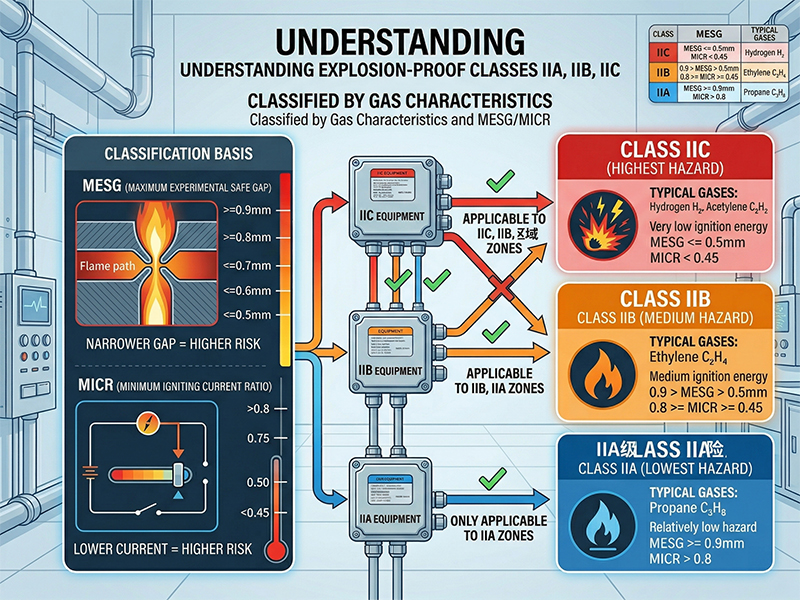
The danger of an explosive mixture is determined by several factors, including the explosion limit, flame transmission capability, ignition temperature, and minimum igniting current.
Classification of Explosive Mixtures
Based on the danger of explosive mixtures and the characteristics of actual production processes, explosive mixtures are usually classified into three main categories: I, II, and III. These are respectively represented as:
- Class I: Coal mine methane
- Class II: Explosive gas mixtures (e.g., factory explosive gases, vapors, and mists)
- Class III: Industrial dusts (e.g., explosive dusts and flammable fibers)
Category II indicates explosive gas mixtures, which exclude coal mine methane but include factory explosive gases, vapors, and mists. Class II explosive gas mixtures are further subclassified into IIA, IIB, and IIC based on the maximum experimental safe gap (MESG) and minimum igniting current ratio (MICR).
The Role of MESG and MICR
Based on specific environmental requirements, gases or vapors are classified and graded so that flameproof or intrinsically safe electrical equipment can be manufactured accordingly to ensure corresponding explosion-proof safety performance.
For flameproof electrical equipment, gases and vapors are graded by the Maximum Experimental Safe Gap (MESG). For intrinsically safe electrical equipment, gases and vapors are graded by the Minimum Igniting Current Ratio (MICR), which is defined as the ratio of the minimum igniting current to that of laboratory methane.
The classification of gases and vapors is consistent with that of flameproof and intrinsically safe electrical equipment, which is divided into two primary categories:
- Class I: Electrical equipment intended for use in underground coal mines (methane).
- Class II: Electrical equipment intended for use in all other explosive gas atmospheres excluding coal mines.
Breakdown of IIA, IIB, and IIC Levels
Class II electrical equipment is further divided into IIA, IIB, and IIC levels based on the MESG and MICR of the applicable explosive gas mixtures. This is consistent with the gas and vapor classification. Equipment marked as IIB can be applied to the use conditions of IIA equipment, while equipment marked as IIC can be applied to the conditions of both IIA and IIB. The highest explosion-proof level is represented by the IIC mark.
Class IIA
Propane is represented as the typical gas for Class IIA explosive gas mixtures. Corresponding Class IIA explosion-proof equipment is applied to locations where a Class IIA explosive gas environment may occur during normal operation, such as environments containing propane. A relatively low environmental hazard is presented by Class IIA.
Class IIB
Ethylene is represented as the typical gas for Class IIB explosive gas mixtures. A hazard level between IIA and IIC is exhibited by it. Corresponding Class IIB explosion-proof equipment is applied to locations where a Class IIB explosive gas environment may occur.
Class IIC
Hydrogen and acetylene are represented as the typical gases for Class IIC explosive gas mixtures. Because a very low ignition energy is possessed by these gases, the highest hazard level is presented. Corresponding Class IIC explosion-proof equipment is applied to locations where a Class IIC explosive gas environment may occur.
Explosive Gas Grouping Table
An explosive gas grouping table is attached below. Temperature groups are added for configuring appropriate explosion-proof electrical equipment so that safe production can be achieved.
| Class & Level | MESG (mm) | MICR | Temperature Group | |||||
|---|---|---|---|---|---|---|---|---|
| T1 | T2 | T3 | T4 | T5 | T6 | |||
| I | MESG = 1.14 | MICR = 1.0 | Methane | |||||
| IIA | MESG ≥ 0.9 | MICR > 0.8 | Toluene, Ethane, Propane, Acetone, Benzene, Styrene, Carbon Monoxide, Acetic Acid, Ammonia | Methanol, Ethanol, Ethylbenzene, Propanol, Propylene, Butanol, Cyclopentane | Pentane, Hexane, Heptane, Octane, Turpentine, Naphtha, Petroleum, Fuel Oil | Acetaldehyde, Trimethylamine | Ethyl Nitrite | |
| IIB | 0.9 > MESG > 0.5 | 0.8 ≥ MICR ≥ 0.45 | Acrylonitrile, Dimethyl Ether, Town Gas | Butadiene, Propylene Oxide, Ethylene | Dimethyl Ether, Acrolein, Hydrogen Sulfide | Ethyl Ether, Diethyl Ether | ||
| IIC | MESG ≤ 0.5 | MICR < 0.45 | Hydrogen, Water Gas | Acetylene | Carbon Disulfide | Ethyl Nitrate | ||
In conclusion, in locations where explosive gas environments may exist, the selection of explosion-proof grades IIA, IIB, or IIC must be determined by the explosion limit, flame transmission capability, ignition temperature, MICR, and the characteristics of the explosion hazard zone, so that suitable explosion-proof equipment is chosen and safe production is ensured.