


General Provisions
Design specifications must be strictly complied with regarding the type, level, group, environmental conditions, and special markings of explosion-proof electrical equipment.
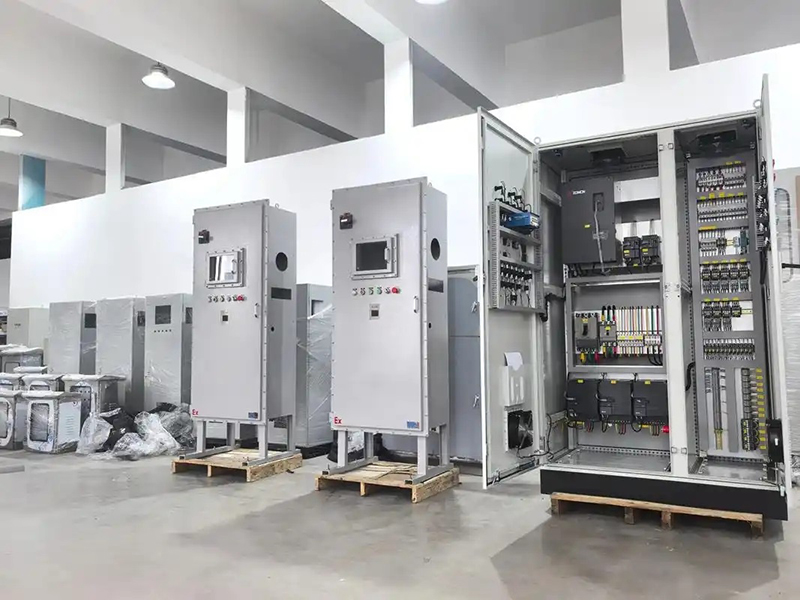
Accuracy and clarity must be maintained for the nameplates, explosion-proof marks, and warning signs of the equipment.
Cracks and damages must be entirely absent from the enclosures and light-transmitting parts of the equipment.
Anti-loosening measures must be applied to fastening bolts, and loosening and rust must be prevented.
Metal brackets should be utilized for equipment installation. Firmness must be ensured for the brackets, and anti-loosening devices must be equipped on the fixing bolts of vibrating electrical equipment.
After internal wiring in the junction box is fastened, the requirements specified in Appendix D must be satisfied by the electrical clearance and creepage distances between bare live parts and between live parts and the metal enclosure.
Suitable blanking elements matching the relevant explosion-proof type must be used to seal redundant cable entries. Except for intrinsically safe equipment, specialized tools must be required for the removal of blanking elements.
Relevant explosion-proof type requirements must be met by cable and conduit connections.
A metal washer must be placed between the sealing ring and the compression element. Product manual requirements must be satisfied by the compression element, and the compression of the cable or wire by the sealing ring must be guaranteed.
Appropriate coordination between the outer diameter of the cable sheath and the inner diameter of the sealing ring must be ensured. Aging phenomena must not be exhibited by the sealing ring.
The following requirements must be complied with during the installation of lighting fixtures:
- Design and technical requirements must be satisfied by the type, model, and power of the lighting fixtures.
- Screw-type bulbs must be tightly screwed to ensure optimal contact, and looseness must be prevented.
- Completeness must be maintained for light covers, and bolts must be securely tightened.
Additional certification must be obtained prior to installation and use when products featuring the “U” suffix in the explosion-proof certificate number are combined with other electrical equipment or systems.
Specific conditions for safe use must be strictly observed when the explosion-proof certificate number bears the “X” suffix.
Additional Requirements for Flameproof “d”
During installation, the distance between the flameproof joint surface and solid obstacles must be kept no less than the values specified in Table 7, unless smaller isolation distances are proven acceptable by testing.
| Gas Classification | Minimum Distance (mm) |
|---|---|
| IIA | 10 |
| IIB | 30 |
| IIC | 40 |
Anti-corrosion measures must be applied to the flameproof surfaces. The ingress of water into joint gaps must be prevented. Gaskets must only be utilized when explicitly permitted by the documentation. Hardening substances must not be applied to joint surfaces. Damage to flameproof surfaces must be avoided during installation.
Applicable joint surface protection measures: Non-condensing grease or anti-corrosive agents may be used. Silicone grease is generally suitable but must be used cautiously on gas detectors. Non-solidifying properties must be prioritized during material selection to prevent compromised joint tightness.
Fastening bolts for flameproof joints must not be arbitrarily replaced, and spring washers must be fully equipped.
Friction must be prevented between the motor shaft and shaft hole, or between the fan and end shield under normal operating conditions.
Relevant equipment standards must be met by cable and conduit entry systems, and the overall explosion-proof performance of the enclosure must be guaranteed. The requirements of GB3836.15 Section 10.3 must be complied with. A minimum engagement of five threads must be achieved between the conduit and the flameproof enclosure.
When steel pipes are required for connection to cable entries, a transitional compression element should be utilized to ensure the sealing ring is compressed before the steel pipe is connected. Live joints may be added if the steel pipe connection is difficult.
If the enclosure is specifically designed for conduit connection but modified for cable connection, a flameproof adapter featuring an insulating sleeve and junction box may be utilized. Connection to the enclosure must be made via a conduit not exceeding 150mm in length. The cable is then routed into the junction box, and corresponding explosion-proof requirements must be met.
Motors Supplied by Variable Frequency and Voltage Power Supplies
The following requirements must be met by motors supplied by variable frequency and voltage power supplies:
- Temperature sensors must be embedded according to relevant motor standards for direct temperature control, or alternative effective measures must be adopted to limit the motor enclosure surface temperature. The motor must be de-energized by the protective device. Joint testing of the motor and inverter is not required; or
- Type tests must be conducted on the motor as a working unit together with the inverter and protective device in accordance with GB3836.1 standards.
Note 1: In certain scenarios, the maximum surface temperature is generated on the motor shaft.
Note 2: For Increased Safety “e” junction boxes utilizing high-frequency pulse outputs, close attention must be paid to potential overvoltage peaks and high temperatures generated within the junction box.
Supplementary Requirements for Increased Safety “e”
An ingress protection rating of no less than IP54 must be maintained for enclosures containing bare live parts, and no less than IP44 for enclosures containing only insulated live parts. A protection rating of IP20 or higher must be applied to rotating machines installed in clean environments that are routinely supervised.
Effective connection between cables and increased safety equipment must be achieved using compatible entry devices. The explosion-proof type “e” must be preserved, and an IP54 rating must be achieved for the terminal box enclosure combined with sealing elements.
Specified electrical clearances and creepage distances must be guaranteed during internal wiring of the junction box. If multiple conductors are connected to a single terminal, secure clamping of each conductor must be rigorously verified.
Additional Requirements for Intrinsic Safety “i”
The requirements of GB3836.4, satisfying at least category “ib”, must be complied with by intrinsically safe circuits, equipment, and associated apparatus installed in Zone 1 and Zone 2.
A test voltage of at least 500V AC must be withstood by the insulation of intrinsically safe circuit cables between conductor and ground, conductor and shield, and shield and ground.
Electrical parameters (CC and LC, or CC and LC/RC) must be known for all utilized cables, or the most unfavorable values specified by the manufacturer must be adopted.
Interference from external electromagnetic fields must be prevented for intrinsically safe circuit installations. This isolation can be achieved by utilizing shielding, twisted cables, or maintaining adequate physical distance. The following requirements must be satisfied by cables across all zones:
- Physical isolation must be maintained between intrinsically safe and non-intrinsically safe circuit cables; or
- Mechanical damage protection must be provided during cable routing; or
- Armored, metal-sheathed, or shielded cables must be utilized.
Intrinsically safe and non-intrinsically safe conductors must be strictly segregated and never housed within the same cable.
Insulation layers or grounded metal barriers must be utilized to isolate intrinsically safe and non-intrinsically safe conductors bundled together.
Clear identification must be provided for cables containing intrinsically safe conductors. If the sheath is color-coded, light blue must be applied. Such cables must be strictly prohibited from being utilized for other purposes. Marking is exempted if cables are already armored or shielded.
The requirements of GB3836.4 category “ia” must be met by installations in Zone 0. Associated apparatus featuring galvanic isolation between intrinsically safe and non-intrinsically safe circuits must be prioritized.
The requirements of GB3836.15-2000 Section 12 must be satisfied by the installation of intrinsically safe electrical equipment.
Supplementary Requirements for Pressurized Enclosure “p”
Beyond standard overall checks, compliance with equipment documentation and this standard must be rigorously verified by certified professionals for all installations.
The protective gas intake location must be established in a non-hazardous area, excluding bottled protective gas configurations.
The protective gas exhaust must be located in a non-hazardous area; otherwise, spark and particle blocking devices must be installed according to Table 8.
| Exhaust Area | Equipment A | Equipment B |
|---|---|---|
| Zone 2 | Required | Not Required |
| Zone 1 | Required | Required |
A limited hazardous area might be generated at the duct exhaust during the purging process.
Pressure supply equipment must be installed in non-hazardous areas. Corresponding explosion-proof measures must be implemented if the driving motor or control device is unavoidably installed within the supply duct or hazardous area.
If an ignition hazard is posed by the equipment temperature during a pressurization failure, protective devices must be installed inside the pressurized enclosure to prevent the rapid ingress of combustible gases.
The requirements specified in Table 9 must be met during a protective gas failure for equipment lacking an internal source of release.
| Zone Classification | Unsuited for Zone 2 when Unpressurized | Suited for Zone 2 when Unpressurized |
|---|---|---|
| Zone 2 | Alarm | No action required |
| Zone 1 | Alarm and de-energize | Alarm |
Installations featuring an internal source of release must be executed precisely according to manufacturer instructions. Alarms must be triggered and corrective measures adopted to guarantee system safety in the event of a protective gas failure.
The requirements for shared safety devices across multiple pressurized enclosures are specified in GB3836.5-2000.
Purging Procedures
The minimum purging time specified by the manufacturer must be extended by an additional duration calculated from the duct volume. In Zone 2, purging may be omitted if the internal environment remains substantially below the lower explosive limit (e.g., 25% LEL). Gas detectors may be utilized to confirm the absence of combustible gases.
Non-combustible, non-toxic gases completely free of moisture, oil, dust, and chemicals must be utilized for purging and pressurization. Air is typically deployed, while inert gases are occasionally used. The oxygen concentration of the protective gas must never exceed ambient air levels.
If air is utilized, the intake source must be situated in a non-hazardous area, and contamination risks caused by wind direction and building proximity must be mitigated during site selection.
The temperature at the protective gas inlet should generally be maintained below 40°C. Wiring systems must be rigorously sealed to prevent the diffusion of combustible gases or the leakage of protective gas.
Additional Requirements for Oil-immersed “o”
Cracks and oil leaks must be completely absent from tanks and oil level indicators, and the oil level must be strictly maintained within the designated marker range.
Oil drain and exhaust holes must be kept clear, and the accumulation of debris must be prevented.
Vertical installation must be maintained, and the inclination angle must not exceed 5 degrees.
A maximum oil surface temperature rise of 60°C is permitted for temperature groups T1-T5, while a maximum surface temperature of 40°C is strictly enforced for T6.
Supplementary Requirements for Zone 2 Equipment
Minimum ingress protection ratings of IP54 and IP44 are specified for enclosures containing bare live parts and insulated live parts, respectively.
If adequate protection against foreign objects is natively provided by the installation environment, IP4X and IP2X ratings may be adopted.
These strict requirements may be waived if the ingress of solid objects and water does not compromise the safety performance of the equipment (e.g., strain gauges, thermocouples).
For energy-limited equipment, the permitted maximum capacitance and inductance values must not be exceeded by the combined total of internal and cable parameters.
Cable and conduit wiring systems must be installed according to specifications, and the following supplementary requirements for entry devices must be fulfilled:
- Connections must be executed using perfectly matched cable entry devices.
- Suitable sealing elements must be utilized to secure the protection rating of the wiring cavity.
- Restricted breathing capabilities must be fully guaranteed by the enclosure seals.
- Unused entry openings must be securely plugged.
Conductor Terminals
Multiple conductors may be accommodated by specific terminals, such as slot-type designs. Firm clamping of every single conductor must be ensured if multiple wires are introduced simultaneously. Conductors with varying cross-sections must not be connected to the same terminal unless explicitly permitted by prior documentation.
If a short-circuit risk is present between adjacent terminals on a terminal board, the insulation of each conductor must be kept continuous right up to the metal terminal junction.