


Il existe différents types de boîtiers antidéflagrants, chacun étant adapté à des domaines d'utilisation spécifiques. Voyons quelles sont les différences de fonctionnalité entre les boîtes de jonction antidéflagrantes et les boîtes de distribution antidéflagrantes.
Fonctionnalité
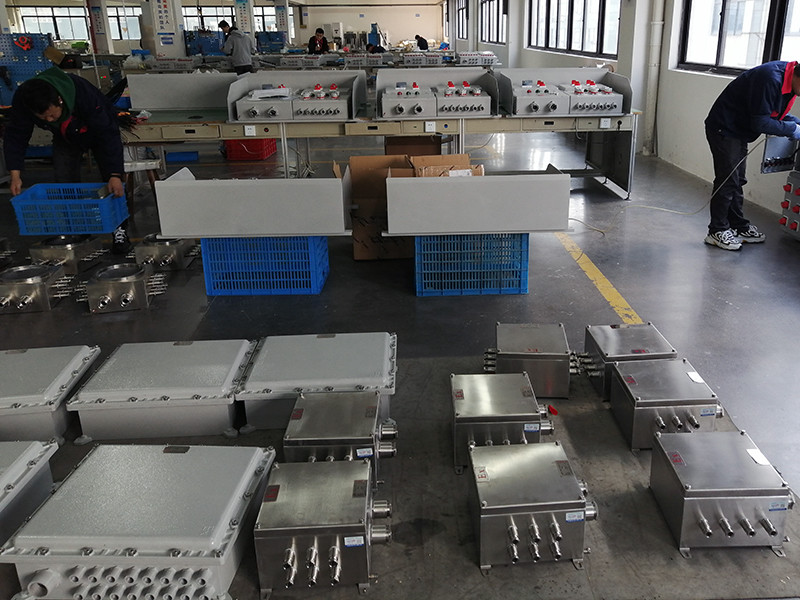
Boîtes de jonction antidéflagrantes : comme leur nom l'indique, il s'agit de boîtiers de raccordement pour le câblage. Elles sont principalement utilisées pour les pontages de transition, les dérivations ou les raccordements croisés. Ces boîtiers contiennent principalement des connecteurs de différentes spécifications et en différentes quantités.
Coffrets de distribution antidéflagrants : ils sont principalement destinés à assurer la distribution électrique dans les zones à risque et à commander les équipements. Ils prennent en charge la la distribution d'énergie électrique, en assurant la protection des lignes et des appareils électriques. À l'intérieur, ils sont équipés de bornes et d'autres composants, notamment des éléments essentiels tels que des disjoncteurs et des fusibles, qui assurent la distribution de l'électricité entrante.
Taille
D'un point de vue visuel, les boîtiers de raccordement antidéflagrants classiques présentent une façade sobre, avec très peu d'ouvertures sur le panneau, à l'exception des orifices réservés aux câbles d'entrée et de sortie. Les modèles personnalisés peuvent varier. En général, ces boîtiers sont plus petits que les coffrets de distribution et doivent être installés à l'intérieur, conformément aux schémas de distribution des circuits primaires et secondaires. Ils contiennent également des composants associés, tels que des contacteurs CA, des relais et des disjoncteurs, ce qui explique leur taille plus importante.
De plus, les variations de taille dépendent du nombre de composants présents à l'intérieur d'un boîtier de raccordement, qui sont généralement compacts, tandis que La taille des coffrets de distribution varie considérablement en fonction des schémas de câblage et des circuits de commande. Certains coffrets de distribution peuvent être de type armoire, ce qui rend leur identification plus intuitive sans avoir à recourir à une inspection visuelle ou à un examen direct de leur configuration interne.
Prix
À processus de fabrication et matériaux égaux, les facteurs influant sur le prix comprennent le volume du boîtier, la disposition des panneaux, le nombre et la taille des entrées et sorties, la configuration interne, ainsi que la marque des composants internes. En termes de matériaux, les caisses en alliage d'aluminium sont les plus abordables, celles en acier se situent dans une gamme de prix modérée, tandis que celles en acier inoxydable sont relativement plus chères. Cependant, chaque matériau répond à des besoins différents : l'alliage d'aluminium présente des contraintes de dimensions, l'acier convient aux dimensions hors normes, et l'acier inoxydable se distingue par sa résistance à la corrosion, ce qui explique son prix plus élevé.