 Shenhai Explosion-Proof

Product Encyclopedia
Explore our detailed product encyclopedia for in-depth knowledge about our explosion-proof offerings.
-
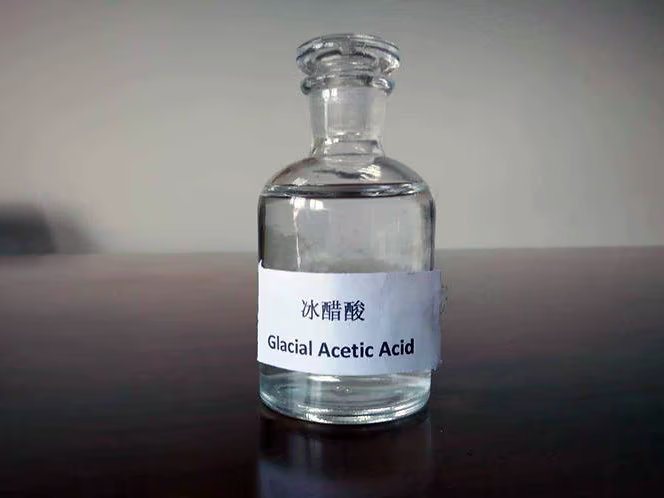
Is Glacial Acetic Acid Flammable
Acetic acid is, in fact, an organic substance comprised of carbon atoms. These carbon atoms are not in their highest oxidation state, as their average valency stands at zero. Therefore, with appropriate conditions, it can undergo oxidation by oxygen, indicating its capability to combust. -

Is Gunpowder a Flammable Substance
Matches fall under the category of flammable solids, and gunpowder is categorized as an explosive substance. Due to the necessity of an open flame for ignition, gunpowder doesn't qualify as a flammable material per se. -

Is Gunpowder Considered an Explosive
Gunpowder falls under the category of explosives, a subset of hazardous materials. These materials encompass a range of substances known for their flammability, explosiveness, corrosive nature, toxicity, and radioactivity. Examples include gasoline, gunpowder, concentrated acids and bases, benzene, naphthalene, celluloid, and peroxides. It's imperative that these materials are managed according… -

Will Gunpowder Explode at High Temperatures
Under extreme heat and pressure, gunpowder is prone to spontaneous combustion, leading to explosive outcomes. A visit to the Third Fireworks Factory in Anping County on July 16th, around 10 a.m., revealed this stark reality. The southeastern and southwestern sections of the storeroom, specifically designated for gunpowder, were reduced to… -

Can Gunpowder Burn in a Vacuum
Black powder is uniquely capable of ignition in a vacuum, independent of atmospheric oxygen. Rich in potassium nitrate, its decomposition liberates oxygen, which then vigorously reacts with embedded charcoal and sulfur. This intense reaction produces significant heat, nitrogen gas, and carbon dioxide, demonstrating the powder's potent exothermic properties.