 Shenhai Explosion-Proof

Technical Specifications
Provides detailed technical data and performance indicators for each explosion-proof product, ensuring compliance with industry standards.
-

Material of Explosion-Proof Flexible Conduit
1. Rubber: Featuring an inner tube of galvanized steel strip and an outer layer of black rubber hose, with carbon steel at both ends, this conduit is favored for its corrosion resistance, waterproof qualities, flame retardance, high flexibility, and softness. Its affordability makes it a popular choice in many industrial… -

How to Classify Explosion-Proof Levels
Explosive gas environments are categorized into three levels—A, B, and C—based on the maximum experimental safe gap or the minimum ignition current required. [table id=216 /] Devices are organized into six temperature classifications, ranging from T1 to T6, determined by the maximum allowable surface temperature. -
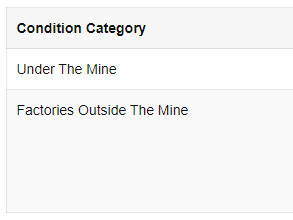
Explosion-Proof Level DII BT4 and DII CT4
The IIC classification exceeds the IIB classification and serves as a reference for designing electrical equipment in explosive environments. [table id=165 /] All devices fall under the T4 temperature classification, where the maximum allowable surface temperature is capped at 135°C. -

Explosion-Proof Zone 20 Corresponds to the Explosion-Proof Level
If an area requires the installation of dust explosion-proof electrical devices, the explosion-proof standards for equipment in Zone 20 must exceed those required for Zones 21 and 22. [table id=213 /] Specifically, in Zone 20, only intrinsically safe or encapsulated devices are permissible, while flameproof devices are not allowed. -
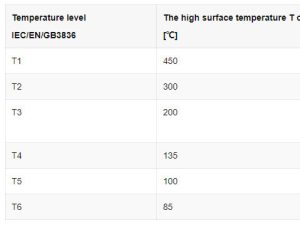
Explosion-Proof Level T6 Can Be Used with T2
Keep in mind that T2 is considered inferior, while T6 represents the optimal temperature classification! Hence, devices with a T6 explosion-proof rating are more than adequate for environments requiring T2 standards. [table id=163 /] T6 devices are designed to operate at temperatures not exceeding 85°C, compared to T2 devices, which…