


| Name | Characteristics | Hazards |
|---|---|---|
| Carbon dioxide (CO2) | Colorless and odorless | When the concentration is between 7% and 10%, it suffocates and causes death |
| Water (H2O) | Steam | |
| Carbon monoxide (CO) | Colorless, odorless, highly toxic, flammable | Death caused by concentration of 0.5% within 20-30 minutes |
| Sulfur dioxide (SO2) | Colorless and odorless | Short term death caused by 0.05% concentration |
| Phosphorus pentoxide (P2O5) | Causing cough and vomiting | |
| Nitric oxide (NO) and nitrogen dioxide (NO2) | Smelly | Short term death caused by 0.05% concentration |
| Smoke and smoke | Varies by composition |
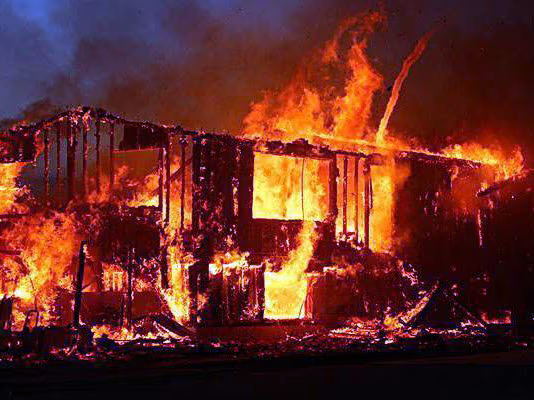
Beyond water vapor, the majority of byproducts from combustion are detrimental.
Smoke clouds visibility, complicating evacuation efforts during fires by obscuring sight. The intense thermal convection and radiation from high-temperature combustion can ignite additional flammables, spawning new ignition points, and potentially trigger explosions. Residues from complete combustion exhibit flame-retardant properties. Combustion halts when carbon dioxide levels hit 30%.