 Shenhai Explosion-Proof

Stay informed with the latest news and updates in the explosion-proof industry from our comprehensive news center.
-

What Does Explosion-Proof Level AT4 Mean
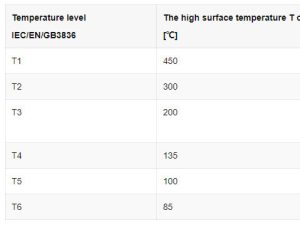
A: Propane gas exemplifies Class A environments. [table id=216 /] T4: The 'T' denotes temperature, categorized into six levels. T4 specifies that the equipment's maximum surface temperature does not exceed 135°C. -
The Difference Between Explosion-Proof Levels IIC and IIIC
These represent completely distinct concepts. [table id=165 /] IIC is typically associated with explosion-proof environments, characterized by substances such as hydrogen and ethyl nitrate. Conversely, IIIC, as defined by national standards, pertains to conductive dust explosions, designated as DIP A21. IIIA covers flammable fibers, and IIIB encompasses non-conductive dust. IIC… -
Which Explosion-Proof Level Is Higher, BT5 or BT4
The BT5 explosion-proof rating is considered high. [table id=216 /] All units are rated at IIB level. However, T4 equipment has a maximum surface temperature limit of 135°C, whereas T5 equipment is limited to 100°C. Lower maximum surface temperatures indicate greater safety. Thus, equipment compliant with BT5 standards is also… -
Which Level of Explosion-Proof Is Higher, CT5 or CT6
The CT6 explosion-proof classification is notably high. Both models are designated as Class C in terms of explosion safety, with T5 and T6 indicating the maximum surface temperatures for the equipment. [table id=163 /] The selection from T1 to T6 is guided by the flash points of hazardous materials, with… -
Which Has the Highest Explosion-Proof Level
Explosion-proof classification: The IIC level is the highest, encompassing the applications of IIB and IIA; IIB exceeds IIA in ranking. [table id=216 /] Maximum surface temperature: This refers to the highest temperature that electrical devices can achieve under the worst specified operating conditions, potentially igniting the surrounding explosive atmosphere. The…