 Shenhai Explosion-Proof

Stay informed with the latest news and updates in the explosion-proof industry from our comprehensive news center.
-

Which Level of Explosion-Proof Is Higher, CT1 or CT4
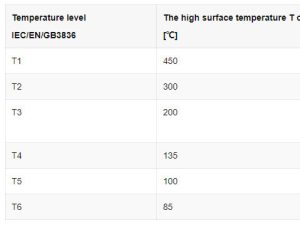
The CT4 explosion-proof classification is considered high. [table id=216 /] All considered, each device holds an IIC rating, indicating uniformity across this metric; however, distinctions are found within their temperature classifications: T6 devices have a maximum surface temperature of 85°C, T4 devices peak at 135°C, and T1 devices can reach… -
What Does Explosion-Proof Level 4 Mean
Explosion-proof designation exdllct4: [table id=211 /] Ex signifies explosion-proof; d represents a flameproof type; IIC indicates a safety gap smaller than 0.5 mm and a current below 0.45A; T4 designates the temperature classification for explosion-proof electrical equipment, specifying that the surface temperature of the explosion-proof equipment must not exceed 135°C. -
What Does Explosion-Proof Level BT4 Mean
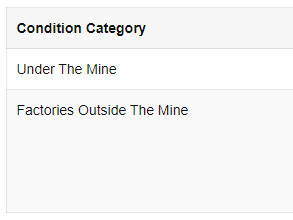
The bt4 rating on explosion-proof equipment indicates two primary parameters. Additionally, the 'b' in bt4 denotes Class IIb, signifying its use in non-mining settings. [table id=216 /] B The 'B' indicates the gas level in the environment, determined through experimental reference levels. This classification primarily accounts for the maximum gaps… -
The Difference Between Explosion-Proof Level BT and CT
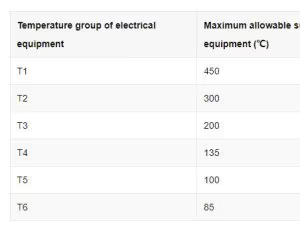
Explosion-proof rating: Explosion-proof equipment with a CT4 rating is classified as Exd IIC T4. BT4 explosion-proof equipment is rated as Exd IIB T4, which is a lower explosion-proof rating than CT4 equipment. [table id=165 /] Applicability: CT has the widest range of applicability. Gas environment: CT is an explosion-proof rating… -
The Difference Between Explosion-Proof Level B and C
Class C offers enhanced safety with more meticulous explosion-proof treatment. [table id=163 /] Flameproof designs typically feature threading rather than insertable components. Class C devices provide longer flameproof surfaces and narrower explosion gaps. Hydrogen, acetylene, and carbon disulfide necessitate the use of IIC class, whereas other substances are adequately served…