


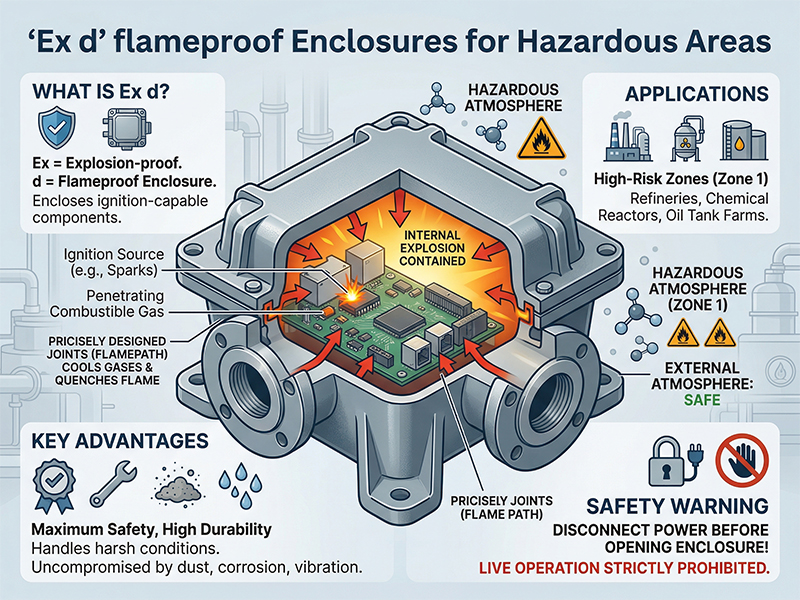
The abbreviation Ex stands for explosion-proof, indicating that the electrical equipment is designed for hazardous areas. The letter d indicates that the flameproof enclosure type is utilized. In this design, components capable of igniting explosive mixtures are enclosed within a robust shell. This enclosure is engineered to withstand the explosion pressure of internal mixtures, and the propagation of the explosion to the surrounding atmosphere is effectively prevented.
Applications in High-Risk Zones
The Ex d flameproof type is considered the preferred choice for high-risk chemical areas and is often regarded as the most robust option in the explosion-proof industry. Whenever continuous leaks of combustible gases or vapors are present—such as in refineries, chemical reactors, and oil tank farms (specifically Zone 1 hazardous environments)—Ex d equipment must be specified.
Explosion-Proof Mechanism
A straightforward explosion-proof mechanism is employed: the instrument circuits are completely sealed within a high-strength enclosure. Even if penetrating combustible gases are ignited by internal circuit sparks, the resulting explosive force is firmly contained by the thick shell. Consequently, large-scale external explosions are entirely prevented.
Advantages and Disadvantages
- Maximum Safety: High durability is provided, and the harshest operating conditions in chemical plants can be handled. The explosion-proof performance is not compromised by dust, corrosion, or vibration.
- Inherent Drawbacks: The enclosures are characterized by heavy weight and high manufacturing costs.
Maintenance Warning & Conclusion: Power must be disconnected before the enclosure is opened for installation or maintenance. Live operation is strictly prohibited, as the explosion-proof structure would be directly compromised. Ultimately, for high-risk explosion zones, Ex d is regarded as the most reliable choice; safety must always be prioritized over cost savings.