


Differences in Protection Principles
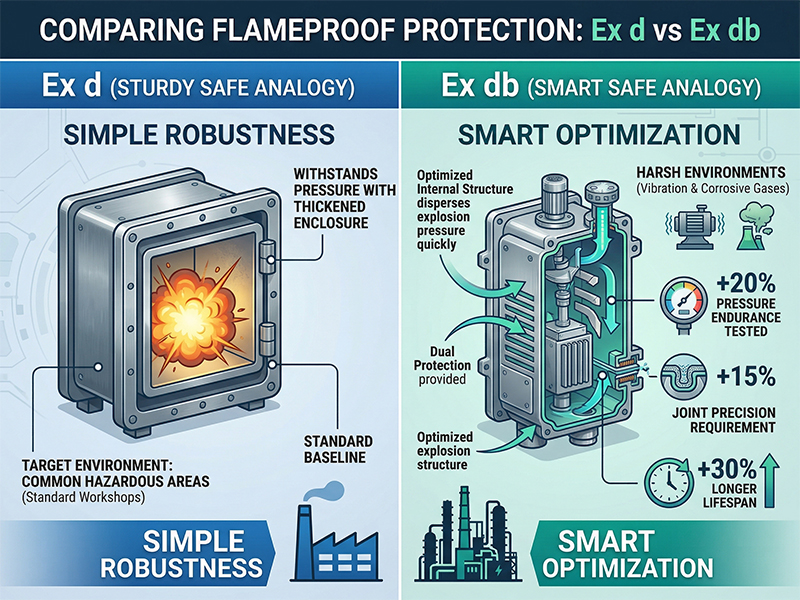
Both Ex d and Ex db are classified as flameproof types, but the latter is considered an upgraded version of the former. The Ex d is structured like a sturdy safe; internal explosion pressure is withstood by a thickened enclosure. Conversely, the Ex db is designed as a smart safe; not only is a robust enclosure provided, but the internal structure is also optimized. Explosion pressure can be dispersed more quickly by it, and a more reliable dual protection is provided.
Specifics of Applicable Environments
Common hazardous areas, such as standard workshops in chemical plants, are perfectly accommodated by the Ex d. In contrast, harsh environments are specifically targeted by the Ex db design, particularly areas where high-frequency vibrations or corrosive gases are present. Under complex conditions, protective performance can still be maintained by it due to the implementation of special sealing and structural reinforcement.
Differences in Safety Levels
Although the same protection goals are shared by both, much stricter tests are passed by the Ex db. Specific safety enhancements are listed as follows:
- An additional 20% of pressure endurance is tested.
- Precision requirements at joints are increased by 15%.
- Continuous vibration tests must be passed.
Consequently, a lifespan that is approximately 30% longer than that of the Ex d under equivalent conditions is achieved by the Ex db.
Technical Comparison Summary
| Parameter | Ex d | Ex db |
|---|---|---|
| Protection Principle | Thickened enclosure | Optimized internal structure |
| Target Environment | Common hazardous areas | Harsh environments |
| Joint Precision | Standard baseline | +15% higher requirement |