 Shenhai Explosion-Proof

Stay informed with the latest news and updates in the explosion-proof industry from our comprehensive news center.
-

What Does Explosion-Proof Level CT6 Mean
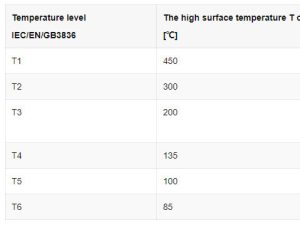
IIC designations are used in environments containing hazardous gases like hydrogen, acetylene, and carbon disulfide, while IIIC designations apply to areas with conductive dust. [table id=216 /] The 'T' classification indicates the maximum surface temperature of equipment: T1 up to 450°C, T2 up to 300°C, T3 up to 200°C, T4… -
Which Level of Explosion-Proof Is Higher, CT2 or CT4
It is evident that CT4 holds a higher explosion-proof rating. Notably, explosion-proof motors feature the IICT4 designation but lack the IICT2 marking. [table id=154 /] This distinction stems from the temperature classifications of explosion-proof electrical devices: T4 devices are designed to maintain a maximum surface temperature below 135°C, whereas T2… -
The Difference Between Explosion-Proof Level CT1 and CT2
The distinction stems from varying temperature classifications, with surface temperatures arranged in descending order from T1 to T6. As a result, CT2 boasts a higher explosion-proof rating and enhanced safety. [table id=154 /] CT surpasses BT, offering the widest coverage. Specifically designed for acetylene, CT excels in environments where BT… -
What Does Explosion-Proof Level CT1 Mean
The correct classification is IICT1, which permits the use with IIC class explosive gases. [table id=216 /] The T1 classification specifies that the equipment's maximum surface temperature must not exceed 450°C. An "Ex" prefix should be present, signifying compliance with European explosion-proof standards. -
Explosion-Proof Level BT5 and CT5
Both groups are classified under T5, which specifies that the maximum surface temperature for explosion-proof electrical devices must not exceed 100°C. [table id=165 /] Explosion-proof standards are categorized into three levels: IIA, IIB, and IIC, with IIC ranking above both IIB and IIA. Ultimately, CT5 holds a superior explosion-proof classification…