 Shenhai Explosion-Proof

Explanation Of Terms
Understand key terms and concepts in the explosion-proof sector with our clear, concise terminology explanations.
-
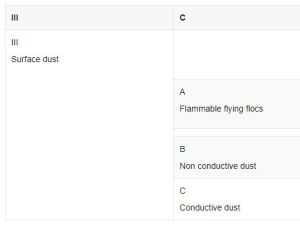
Explosion-Proof Level Db
Db represents a new national standard in explosion-proof markings and protection levels, specifically designed for devices in dust environments applicable to Zones 21 and 22. [table id=280 /] An example is DIP A21 TA T6 Db DIP, indicating a device for dust environments; if labeled as Ex, it indicates suitability… -
Explosion-Proof Level Da Db Dc
Gb: Specifies protection levels for Category 1 and 2 devices. Importantly, the updated explosion-proof markings further divide the flameproof category into da, db, and dc. [table id=288 /] da: Designed exclusively for catalytic sensors in combustible gas detectors, and is approved for use in Zone 0. db: A prevalent standard,… -
What Is the Temperature for Explosion-Proof Level T4
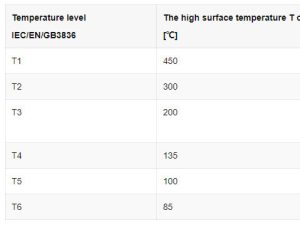
The T4 classification specifies that electrical devices must operate with a maximum surface temperature of no more than 135°C. Products with a T6 rating are applicable across various temperature groups, whereas T4 devices are compatible with T4, T3, T2, and T1 conditions. [table id=163 /] The reason T6 is not… -
Explosion-Proof Levels T1 and T6
The explosion-proof classification T6 surpasses that of T1; [table id=163 /] Explosion-proof devices classified under T1 are required to maintain a surface temperature not exceeding 450°C, while those classified under T6 must not exceed a surface temperature of 85°C; Undoubtedly, T6 offers enhanced safety. -

What Does Explosion-Proof Level CT6 Mean
IIC designations are used in environments containing hazardous gases like hydrogen, acetylene, and carbon disulfide, while IIIC designations apply to areas with conductive dust. [table id=216 /] The 'T' classification indicates the maximum surface temperature of equipment: T1 up to 450°C, T2 up to 300°C, T3 up to 200°C, T4…