

The abbreviation for Explosive, “Ex”, is used to represent “explosion-proof”. It is internationally recognized as the mark for explosion-proof electrical equipment.
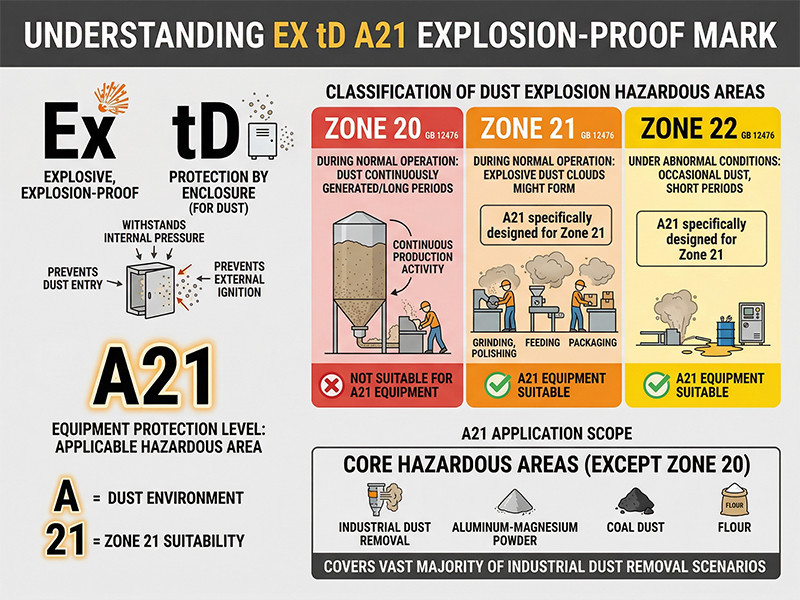
The explosion-proof type of the equipment is indicated by “tD” as “protection by enclosure”. The core principle is established: external combustible dust is prevented from entering the interior by the equipment enclosure. Simultaneously, sufficient mechanical strength is possessed by the enclosure, so that the pressure generated by potential internal dust explosions can be withstood without damage. Furthermore, the external environment is prevented from being ignited by internal flames and high-temperature gases.
The equipment protection level is represented by “A21”. This is considered the most critical part of the identification, by which the applicable hazardous area of the equipment is directly defined. The application in a dust environment is represented by “A” (while a gas environment is represented by the corresponding “G”). The suitability of the equipment for Zone 21 is represented by “21”.
Classification of Dust Explosion Hazardous Areas
According to the national standard GB 12476, dust explosion hazardous areas are classified into the following zones:
- Zone 20: Areas where combustible dust is continuously generated or maintained for long periods during normal operation.
- Zone 21: Areas where an explosive environment might be formed by the mixture of combustible dust clouds and air during normal operation (e.g., near workstations for grinding, polishing, feeding, and packaging).
- Zone 22: Areas where dust clouds are occasionally generated and maintained for a short period under abnormal conditions.
Application Scope of A21 Equipment
Explosion-proof equipment marked with “A21” is specifically designed to be utilized in core hazardous areas where explosive dust clouds are generated during normal production, such as areas with aluminum-magnesium powder, coal dust, and flour. The more dangerous Zone 20 is not suitable for this equipment, but the vast majority of industrial dust removal application scenarios are fully covered by it.