


Two Protection Logics of Explosion-proof Motors
Different protective configurations are utilized by Ex tB and tD motors. Internal sparks are isolated by tB structures (such as increased safety designs), which are deemed suitable for environments where combustible gases are occasionally encountered. Conversely, a completely sealed enclosure is provided by tD structures (such as encapsulated designs), which are specifically deployed for dust-filled conditions.
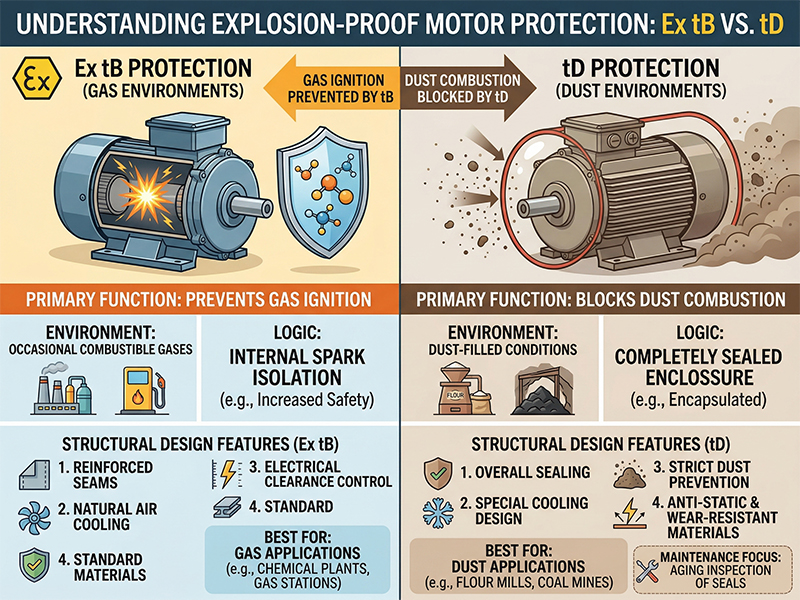
The key difference is identified as follows: gas ignition is prevented by tB, while dust combustion is blocked by tD.
Explicit Differences in Structural Design
| Design Aspect | Ex tB Features | tD Features |
|---|---|---|
| Enclosure Craftsmanship | Reinforced seams | Overall sealing |
| Cooling Method | Natural air cooling | Special cooling design |
| Internal Clearance | Electrical clearance control | Strict dust prevention |
| Material Selection | Standard materials | Anti-static and wear-resistant |
Practical Selection Guide
The selection between tB and tD is frequently evaluated. The following fundamental rule should be remembered: tB is recommended for gases (chemical plants, gas stations), while tD is utilized for dust (flour mills, coal mines). Composite protection is required by mixed environments, and the sealing advantages of tD are prioritized in wet and dusty locations.
During maintenance, special attention must be paid to the aging inspection of seals for tD motors.